Quelques problèmes en Answer Set Programming
Cette page rassemble quelques solutions en Answer Set Programming (avec Clingo) à une sélection de problèmes de logique originaires de sources diverses et variées.
Brilliant Order logic
Source: https://brilliant.org
Qu°1
- 4 is before 1 and 2.
- 3 is after 1 and 2.
- 2 is before 1.
#const n=4.

values(1..n).
before(4, (1;2)).
after(3, (1;2)).
before(2, 1).


values(1..n).

after(After, Before) :- before(Before, After).
before(Before, After) :- after(After, Before).

n { position(Value, Position): values(Value), values(Position) } n.

:- position(Value, Position1), position(Value, Position2) , Position1 != Position2.
:- position(Value1, Position), position(Value2, Position) , Value1 != Value2.


Position1 < Position2 :- before(Value1, Value2) , position(Value1, Position1), position(Value2, Position2).

#show position/2.
4,2,1,3
Qu°2
- 1 is after 4 and before 2.
- 2 and 4 are after 3.
The same inference rules can be used, only the input data changes.
#const n=4.


values(1..n).

after(After, Before) :- before(Before, After).
before(Before, After) :- after(After, Before).

n { position(Value, Position): values(Value), values(Position) } n.

:- position(Value, Position1), position(Value, Position2) , Position1 != Position2.
:- position(Value1, Position), position(Value2, Position) , Value1 != Value2.


Position1 < Position2 :- before(Value1, Value2) , position(Value1, Position1), position(Value2, Position2).

#show position/2.

after(1, 4).
before(1, 2).
after((2; 4), 3).
3,4,1,2
Qu°3
- 4 is before 1 and 2
- 3 is after 1 and 2
- 2 is before 1
#const n=4.

values(1..n).

after(After, Before) :- before(Before, After).
before(Before, After) :- after(After, Before).

n { position(Value, Position): values(Value), values(Position) } n.

:- position(Value, Position1), position(Value, Position2) , Position1 != Position2.
:- position(Value1, Position), position(Value2, Position) , Value1 != Value2.


Position1 < Position2 :- before(Value1, Value2) , position(Value1, Position1), position(Value2, Position2).

#show position/2.

before(4, (1;2)).
after(3, (1;2)).
before(2, 1).
4,2,1,3
Qu°4
- 1 is after 4 and before 2.
- 2 and 4 are after 3.
#const n=4.


values(1..n).

after(After, Before) :- before(Before, After).
before(Before, After) :- after(After, Before).

n { position(Value, Position): values(Value), values(Position) } n.

:- position(Value, Position1), position(Value, Position2) , Position1 != Position2.
:- position(Value1, Position), position(Value2, Position) , Value1 != Value2.


Position1 < Position2 :- before(Value1, Value2) , position(Value1, Position1), position(Value2, Position2).

#show position/2.

after(1, 4).
before(1, 2).
after((2;4), 3).
3,4,1,2
Qu°5
- 4 is before 3 and 2.
- 1 is after 3.
- 2 is after 1.
#const n=4.


values(1..n).

after(After, Before) :- before(Before, After).
before(Before, After) :- after(After, Before).

n { position(Value, Position): values(Value), values(Position) } n.

:- position(Value, Position1), position(Value, Position2) , Position1 != Position2.
:- position(Value1, Position), position(Value2, Position) , Value1 != Value2.


Position1 < Position2 :- before(Value1, Value2) , position(Value1, Position1), position(Value2, Position2).

#show position/2.

before(4, (3;2)).
after(1, 3).
after(2, 1).
4,3,1,2
Relative comparisons
The robots are comparing ages to line up correctly.
Put the robots in the correct order using clues about their ages.
- The robot in 4th is older than the robot in 1st.
- The robot is 4th is younger than in neighbor.
- The robot in 2nd is youngest.
The robots have to chose their slots, according to their age, and the slots are:
- 365
- 500
- 700
- 999
#const n=4.

slot(1..n).
robot(365;500;701;999).

% Each slot is associated with a single robot
n { position(Robot, Slot): slot(Slot), robot(Robot) } n.

% Two robots set at the same slot must be the same robot
Robot1 = Robot2 :- position(Robot1, Slot) , position(Robot2, Slot).

% Older means the age is higher
OldRobot > YoungRobot :- older(OldRobot, YoungRobot).
younger(YoungRobot, OldRobot) :- older(OldRobot, YoungRobot).
older(OldRobot, YoungRobot) :- younger(YoungRobot, OldRobot).

% The robot in 4th slot is older than the robot in 1st
older(Robot4, Robot1) :- position(Robot4, 4) , position(Robot1, 1).

% The robot in 4th slot is younger than its neighbor (i.e, the robots in 3th).
younger(Robot4, Robot3) :- position(Robot4, 4) , position(Robot3, 3).

% The robot in 2nd slot is the youngest
OtherAge > Robot2Age :- position(Robot2Age, 2) , position(OtherAge, OtherPosition), OtherPosition != 2.

#show position/2.
500,365,999,701
Dans le mille
Dans quel(s) cercle(s) concentrique(s) de cette cible inhabituelle, et combien de fois devrait-on tirer au minimum pour atteindre le chiffre 100 ? (NO_ITEM_DATA:odellProblemesPourSuper1981)
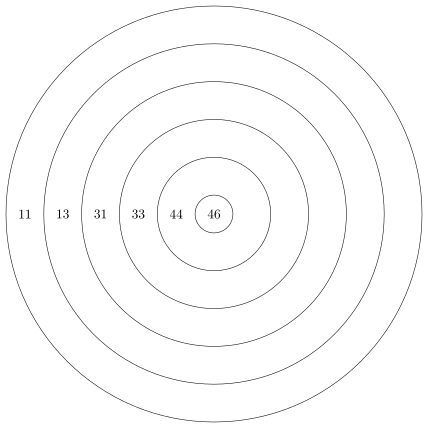
#const objectif=100. % On cherche à atteindre ce chiffre.

% Les valeurs de chaque cercle concentriques de la cible
cercle(11;13;31;33;42;44;46).

% On choisit le nombre de fois où on tire une flèchette sur le cercle C
{ flechettes(Cercle, Count) : cercle(Cercle), Count = 0..10 }.
% On s'assure que chaque cercle est compté une seule fois
Count1 = Count2 :- flechettes(Cercle, Count1), flechettes(Cercle, Count2).

% On compte le score fait sur chaque cercle
cercle_score(Cercle, Count * Cercle) :- cercle(Cercle) , flechettes(Cercle, Count).

% On fait la somme pour le score total
score(Total) :- #sum { Score : cercle_score(_, Score) } = Total.

% On s'assure que le total fait bien le chiffre visé
:- score(Total) , objectif != Total.

% On compte le nombre de flèchettes utilisées
tirs(N) :- #sum { Count: flechettes(_, Count) } = N.

% On minimize le nombre de flèchettes utilisées
#minimize { N: tirs(N) }.

#show tirs/1.
#show score/1.
#show flechettes/2.
clingo version 5.8.0
Reading from /tmp/babel-TPw3fw/clingo-ulx9zx
Solving...
Answer: 1 (Time: 4.983s)
flechettes(11,2) flechettes(13,6) tirs(8) score(100)
Optimization: 8
OPTIMUM FOUND

Models       : 1
  Optimum    : yes
Optimization : 8
Calls        : 1
Time         : 7.772s (Solving: 2.81s 1st Model: 0.03s Unsat: 2.79s)
CPU Time     : 7.771s
References
Odell & Charette (1981) Problèmes Pour Super - Cracks.